Friday, October 28, 2022

Dia de los Muertos ( The day of the Dead)


Five facts about Día de los Muertos (The Day of the Dead)


           José Guadalupe Posada's depiction of La Calavera Catrina, shown wearing a fanciful early 20th century hat.


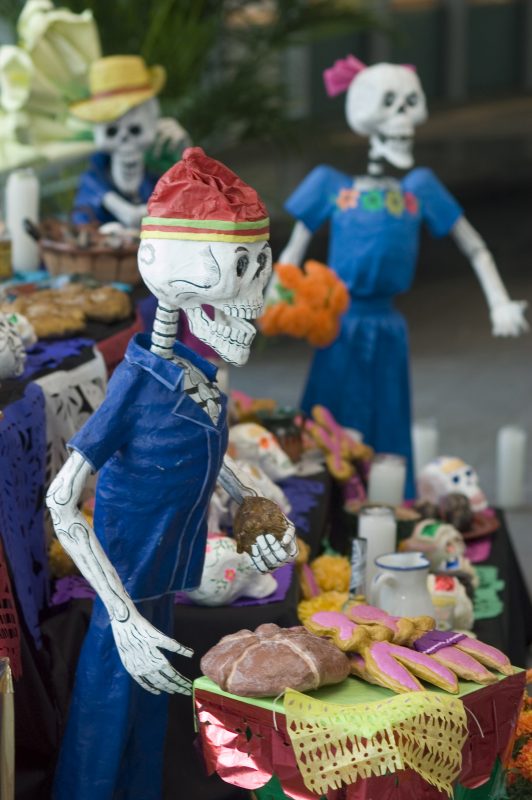
Sugar skulls, monarch butterflies, marigolds and traditional paper banners (papel picado) are all symbols of the Día de los Muertos. (Courtesy of the Smithsonian Latino Center)
Dance group Los Tecuanes perform the “La Danza de los Tecuanes” at a festival celebrating Día de los Muertos at the Smithsonian’s National Museum of the American Indian. (Courtesy of the Smithsonian Latino Center)


1. It’s not the same as Halloween

While Halloween is celebrated Oct. 31, Día de los Muertos is celebrated right after, on Nov. 2. Many communities that celebrate Día de los Muertos also celebrate Halloween.

2. It originated in Mexico and Central America

Día de los Muertos originated in ancient Mesoamerica (Mexico and northern Central America) where indigenous groups, including Aztec, Maya and Toltec, had specific times when they commemorated their loved ones who had passed away. Certain months were dedicated to remembering the departed, based on whether the deceased was an adult or a child.

After the arrival of the Spanish, this ritual of commemorating the dead was intertwined with two Spanish holidays: All Saints Day (Nov. 1) and All Soul’s Day (Nov. 2). Día de los Muertos is often celebrated on Nov. 1 as a day to remember children who have passed away, and on Nov. 2 to honor adults.

Today, Día de los Muertos is celebrated mostly in Mexico and some parts of Central and South America. Recently it has become increasingly popular among Latino communities abroad, including in the United States.

3. It’s a celebration of life, not death

Ancient Mesoamericans believed that death was part of the journey of life. Rather than death ending life, they believed that new life came from death. This cycle is often associated with the cyclical nature of agriculture, whereby crops grow from the ground where the last crop lies buried.

Día de los Muertos is an opportunity to remember and celebrate the lives of departed loved ones. Like any other celebration, Día de los Muertos is filled with music and dancing. Some popular dances include La Danza de los Viejitos—the dance of the little old men—in which boys and young men dress as old men, walk around crouched over then suddenly jump up in an energetic dance. Another dance is La Danza de los Tecuanesthe dance of the jaguars—that depicts farm workers hunting a jaguar.

4. The ofrenda is a central component

The ofrenda is often the most recognized symbol of Día de los Muertos. This temporary altar is a way for families to honor their loved ones and provide them what they need on their journey. They place down pictures of the deceased, along with items that belonged to them and objects that serve as a reminder of their lives.

Every ofrenda also includes the four elements: water, wind, earth and fire. Water is left in a pitcher so the spirits can quench their thirst. Papel picado, or traditional paper banners, represent the wind. Earth is represented by food, especially bread. Candles are often left in the form of a cross to represent the cardinal directions, so the spirits can find their way.
skulls
Traditional calaveras, or skulls, which are prominent on Día de los Muertos. (Courtesy of the Smithsonian Latino Center)


5. Flowers, butterflies and skulls are typically used as symbols

The cempasúchil, a type of marigold flower native to Mexico, is often placed on ofrendas and around graves. With their strong scent and vibrant color the petals are used to make a path that leads the spirits from the cemetery to their families’ homes.

Monarch butterflies play a role in Día de los Muertos because they are believed to hold the spirits of the departed. This belief stems from the fact that the first monarchs arrive in Mexico for the winter each fall on Nov. 1, which coincides with Día de los Muertos.

Calaveritas de azucar, or sugar skulls, along with toys, are left on the altars for children who have passed. The skull is used not as morbid symbol but rather as a whimsical reminder of the cyclicality of life, which is why they are brightly decorated.

Learn more about Día de los Muertos, visit the Smithsonian Latino Center’s Latino Virtual Museum.


Monday, October 24, 2022

The Dred Scott Decision March 6th,1857


Origins of the case. 
Dred Scott's slave master had brought him from the slave state of Missouri to live for a time in free territory and in the free state of Illinois. Eventually they returned to Missouri. Scott believed that because he had lived in free territory, he should be free. In 1854 he sued in federal court for his freedom. The court ruled against him, and he appealed to the Supreme Court.
The Ruling
The Supreme Court ruled that African Americans were not and could never be citizens. Thus, Dred Scott had no right even to file a lawsuit and remained enslaved.


Diwali- Festival of Lights


South India celebrate Diwali as the day that Lord Krishna (depicted above) defeated the demon Narakasura.
PHOTOGRAPH BY MURALI NATH, DREAMSTIME


Diwali: Festival of Lights

Learn about India's biggest holiday of the year.

Diwali, or Dipawali, is India's biggest and most important holiday of the year. The festival gets its name from the row (avali) of clay lamps (deepa) that Indians light outside their homes to symbolize the inner light that protects from spiritual darkness. This festival is as important to Hindus as the Christmas holiday is to Christians.

Over the centuries, Diwali has become a national festival that's also enjoyed by non-Hindu communities. For instance, in Jainism, Diwali marks the nirvana, or spiritual awakening, of Lord Mahavira on October 15, 527 B.C.; in Sikhism, it honors the day that Guru Hargobind Ji, the Sixth Sikh Guru, was freed from imprisonment. Buddhists in India celebrate Diwali as well.


Diwali: What is it?

Diwali is the five-day Festival of Lights, celebrated by millions of Hindus, Sikhs and Jains across the world.

Diwali, which for some also coincides with harvest and new year celebrations, is a festival of new beginnings and the triumph of good over evil and light over darkness.

When is Diwali?

The festival is usually some time between October and November, with the date changing each year.

Where does the name Diwali come from?

The word Diwali comes from the Sanskrit word deepavali, meaning "rows of lighted lamps".

Houses, shops and public places are decorated with small oil lamps called diyas. People also enjoy fireworks and sweets too, so it's really popular with children.

What's the festival about?

Each religion marks different historical events and stories.

Hindus celebrate the return of deities Rama and Sita to Ayodhya after their 14-year exile. They also celebrate the day Mother Goddess Durga destroyed a demon called Mahisha.

Sikhs particularly celebrate the release from prison of the sixth guru Hargobind Singh in 1619. But Sikhs celebrated the festival before this date.

In fact, the foundation stone of the Golden Temple at Amritsar, the most holy place in the Sikh world, was laid on Diwali in 1577.

The founder of Jainism is Lord Mahavira. During Diwali, Jains celebrate the moment he reached a state called Moksha (nirvana, or eternal bliss).

Traditions
  • Many lights and oil lamps are lit on the streets and in houses
  • People visit their relatives and have feasts
  • Fireworks and festivities are an essential part of the occasion
  • Lakshmi, the Hindu goddess of wealth, is worshipped as the bringer of blessings for the new year


The Dalai Lamas are believed by Tibetan Buddhists to be manifestations of Avalokiteshvara or Chenrezig, the Bodhisattva of Compassion and the patron saint of Tibet. Bodhisattvas are realized beings, inspired by the wish to attain complete enlightenment, who have vowed to be reborn in the world to help all living beings.


Sunday, October 23, 2022

James Forten


JAMES FORTEN (1766-1842)


James Forten was born free on September 2, 1766 in Philadelphia, Pennsylvania. His parents were Thomas and Sarah Forten. He was also the grandson of slaves.  His formative years were spent in Philadelphia, and he attended Anthony Benezet’s Quaker school for African American children.  By the time he turned eight years old, he was working for Robert Bridges’s sail loft. This is where his father worked as well. The following year, his father was the victim of an unfortunate boating accident and died. This tragedy resulted in nine-year-old James having to take on additional work to support his family.

Over time, James Forten became interested in politics and avidly campaigned for and supported temperance, women’s suffrage, and equal rights for African Americans.  In 1800, he was the leader in organizing a petition that called for Congress to emancipate all slaves. His activism was further recognized when he wrote and published a pamphlet denouncing the Pennsylvania legislature for prohibiting the immigration of freed black slaves from other states.

James Forten died on March 4, 1842.  His early years had been devoted to providing for his widowed mother, his middle years towards acquiring a vast economic fortune and rectifying the brutal injustices that had been perpetrated upon his fellow African Americans, poor people, and women.

Interactive Civil War

   http://www.history.com/civil-war-150#/who-they-were


http://www.history.com/topics/american-civil-war/stonewall-jackson/videos/stonewall-jackson

Southern Secession


Secession definition: The withdrawal of a state from the Union.


The Civil War Begins

   The Battle of Fort Sumter (April 12–14, 1861) was the bombardment and surrender of Fort Sumter, nearCharleston, South Carolina, that started the American Civil War.


Southern States left the Union upon the election of Abraham Lincoln, declared themselves the Confederate States of America, and seized federal arsenals in the South

When Confederate forces opened fire on Fort Sumter, SC, Lincoln declared the Southern states in rebellion and called for 75,000 volunteers to fight

Memorial Day 2023

  https://www.history.com/veterans-stories https://www.history.com/topics/holidays/memorial-day-history Memorial Day is an American holiday,...